by Swashbuckler on 9/5/2000
favorite track: 7
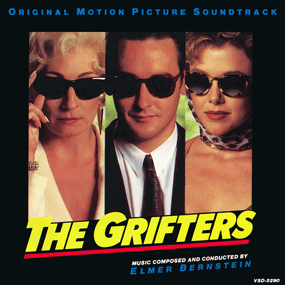
The Grifters is a gritty drama set in a criminal underworld populated by some very unsavory characters. A Martin Scorsese production directed by Stephen Frears, one of its main assets is Elmer Bernstein's enigmatic score.
The music is mixed very prevalently into the film, dryly commenting on every element. As Bernstein mentions in his program notes:
"...the story is told with an odd kind of mordant humor, a touch of reality and a brooding darkness which imbues the whole
with a teasing, elusive quality."
To this end the music is scored primarily for a woodwind and brass chamber orchestra (strings rarely appear) giving it a claustrophobic feel, operating as it does only in the middle registers, but this is offset by Cynthia Millar's piercing electronic sounds.
As usual with an Elmer Bernstein score, the piano is an important element, and in this case it is the piano, along with the electronics, that bring the listener into the score with infectious figures as the score stays carefully neutral about the lifestyles of the characters in the film.
Cues such as "The City" and "Lilly's Argument" offset ambiguous figures with searching piano music and electronics. "Bobo" features interesting "on the move" motives that tie the score to its more traditional film noir roots, along with threatening, low register sounds, scoring the danger represented by the Pat Hingle character.
"Madness" uses the by-now familiar electronics now used in a different context to suggest the state of the title track (it is used in a bizarre scene in the film depicting the fate of J.T. Walsh's character).
"Chase," "Fright and Flight" and "Endings" all feature dark and violent music that takes the score in a new direction. Although the more glib pensive moments are never far away in these cues, the action music is genuinely unsettling (the main title music in the film was this material; a comment by Bernstein in the notes that "the order of music in this album reflects its original placement in the film" implies that the score was subject to quite a bit of shuffling). Often going from quiet reflection into a loud, explosive passage, the music in this stage of the album gets progressively more intense.
A reprise of "The City" material is heard in "Credits," which brings the score back to its beginnings. The finale features a four note ascending motif repeated as the music gradually fades out, leaving the listener to wonder at the end if they're still actually hearing the music or if they only think they're hearing the phrase....
The score also has a very pretty dance track, "Carhumba."
Cynthia Millar herself composed two tracks, "Roy Gambles" and "Roy and Lilly," the former of which features a lighter sound than Bernstein's own writing, and also makes more explicit some of the jazz roots some of the rest of the score manifests (most notably in "Myra's Blues"), while the latter is as moody as the rest of the score, also integrating Bernstein's thematic material.
The album closes with a disco song by Elmer's daughter Emily Bernstein with Pete Theodore that is heard in the film.
The music was produced by Cynthia Millar and was engineered by regular Bernstein collaborator Richard Lewzey. In an interesting production decision, the orchestra is kept pretty much to the center, while the pianos and electronics occupy the outer edges of the stereo soundfield. This works very well in context of the music, giving it an odd, elusive sound.
Dark and probing, yet humorous and entertaining, Elmer Bernstein's score for The Grifters is one of his best in recent years.
see all reviews, or add a review